in a very weird fuked up way, incubus is more enlightened than maya
and the fact that i put enlightenmente os a scale is proff that im infinitly away from it
That’s K6BD in a nutshell. Enlightenment tends to be something that makes you go a bit crazy and have morals antithetical to human norms. Allison is really the only exception, but even she’s a bit morally iffy given the questions raised by Nyave
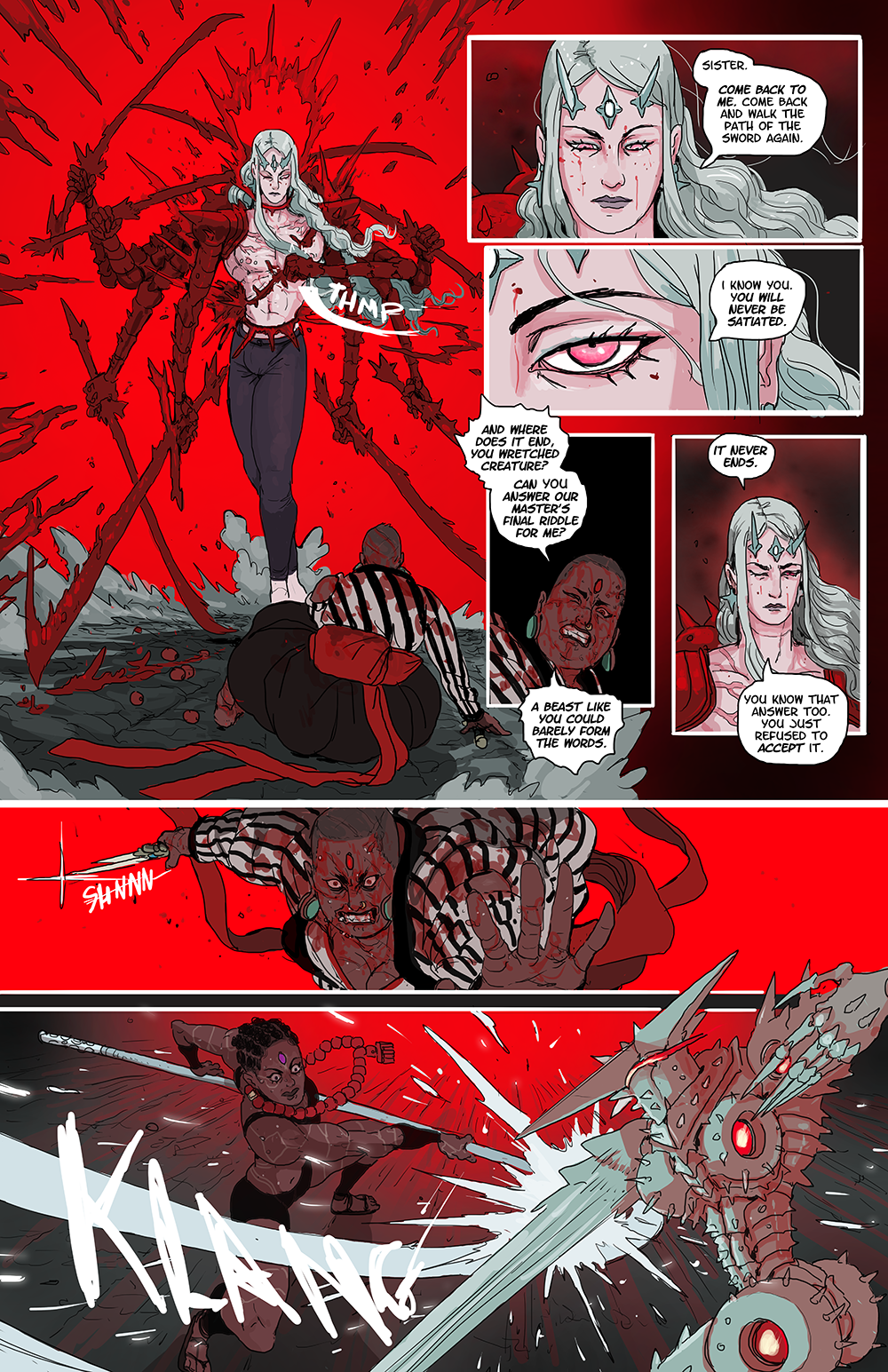
The search of strenght and answers in itself never ends but for the ones who search for it it does in many ways. Some are sudden, some come very slowly but at one point or another it always ends. The way of the sword always ends in death at the end of another sword, for all of them. The only way to avoid it, is to walk away.
Incubus’s favorite sword was used to slay little Ava and also Priya, who was a crybaby, to turn a vegetable farmer into a corpse, to cut 10 times at the neck of a Murderer. He did this in the name of Mathangi ten Meti Murder the Gods and Topple Their Thrones, her name bound in Oxhide beneath his fingers. 1-15-to-1-17.
An exceptionally poor swordsman, he clings above all to his Sister. He is unable to cut her away. Good Hover Text.
Hmm. Both of our heroes fight their destined foe in the wrong arena.
Incubus is a sword, and a sword cannot be killed. He seeks to escape his loneliness, but can only do so in the way of blades.
Juggernaut Star cannot be slain, and so has become a sword. They sublimate themselves in violence and torment to keep from shattering.
They are undefeatable only so long as they are a continuous cutting motion. Deny them that, and they will be undone.
there’s a lot of comments talking about whether incubus does or doesn’t understand royalty and it leaves me kind of confused. Like.
I feel like the story has, again and again, made out royalty to be a pretty bad thing to pursue. Ever. And its all about the tension between power and control and the image of it and how people yearn for it to their own detriment, both yearn for control and yearn to be controlled.
I guess that that’s the “false” Royalty but. Idk man. Is there a “true” royalty that’s better? I think its supposed to be pretty bunk in general.
Royalty is enlightenment. A state of perfect harmony with the world. The path to it is the path of pain and struggle, because KSBD takes the position that violence is fixed in the cosmos. A full reckoning of the world, a total affirmation of it and of oneself, can only come through that path. Self-division, cutting oneself into greater and greater forms, just as God once did. The idiot’s step, which stretches to the horizon.
Nobody ever said it was good. It certainly isn’t desirable—desire for Royalty is prohibitive to obtaining it. It cannot be pursued, only attained. If you want good, become a noodle vendor.
“Lord Intra,” said his bodyguard, “Is the path to Royalty the path of struggle, then?”
“No,” said Intra, “One may attain it without any effort at all. It is, in fact, the antithesis of struggle.”
Yeah, I’m not really clear on this honestly. On the one hand Royalty is repeatedly characterized as being attained without effort, in as simple and smooth a motion as can exist. On the other hand… is this what we actually see in the text? All of our aspirants to Royalty or models of the tenets thereof (Kassardis comes to mind) are people who have absolutely gone through the wringer, have been subject to extraordinary violence and struggle. Intra himself is one such, he was a god of swords. Same with Allison, Zoss, Meti, etc.
Maybe I just misunderstand Intra’s meaning or something about the nature of enlightenment in this world. What is said about the path to Royalty and what is shown don’t seem to match perfectly.
I haven’t really thought this through for the others so much, but I think that Meti and Intra are…actually polar opposites on this:
Meti went through immense struggle when she was younger, with her sword manual saying that she had a harsh training regimen and describing her fight with the Colossus of Pardos.
But she also says that, following that fight, she had a change in mindset, and came to the conclusion that the act of Cutting (“division by the blade of Want”) was all that mattered in a fight.
From there, her philosophy focuses on fighting without thinking — and describes an example of a fight where she didn’t think as “quite pleasant and not difficult at all”.
So, she stopped at struggling after fighting the Colossus — if Royalty is the antithesis of struggle, that’ll be when she achieved it.
Intra, on the other hand, knows what Royalty is, but seems to reject it. The way he dealt with Yem Yeddo’s army, was through constant and exhausting struggle, after all.
And while he uses the term “King of Swords” to describe himself, he never refers to himself as “Royalty”.
In fact, Meti said that “Only the worst kind of idiot strives to be king”, and Intra described himself as “extremely dedicated to foolishness” — whether it’s a rejection of Royalty or not, it at least seems like he’s knowingly choosing a different state of being than Meti, who is referred to as Royalty by both herself and Maya.
(In fact, Meti’s philosophy focuses — and Ryo-ten-Ryam’s, and Maya’s — regards a sword as simply being an instrument for killing. Even Meti having Maya and Incubus cut their hair with a sword, is to have them bathed in death.
But in the Vale of Stalks, Intra comments that he no longer uses his sword to kill, “but it’s very good for cooking dinner”)
Of course, there’s a Ya-at death poem stating that the only step on the path to Royalty “is the idiot’s step” — but Intra himself said that there are no steps, either or both could be wrong.
But Meti only arrived at the realization after living through struggle. We see the same with Kassardis, Allison, Prim, and others related that philosophy of radical affirmation . Royalty may reveal suffering, domination, struggle, and violence to be pointless, but we only see it attained after someone has passed through those things.
Also, I always interpreted Intra as Royalty. People ask him about its qualities all the time, from a position that seems to indicate his special status. He’s the guy who coined the phrase of the continuous cutting motion. Why would the primary instructor on the nature of Royalty be a guy who doesn’t have it? What authority does he have to speak on its nature? From most others like Maya, we only see fragmentary references if any at all. Intra basically gave a lecture on it.
True, Intra is clearly at least believed to be Royalty. I just think that what it means for him, is very different than what it means for someone like Meti, given how he seems to knowingly choose such a different philosophy than her.
(It could even be that there is no universal answer for what Royalty is, that its meaning is subjective. The closest it having to a true nature, being a matter of YISUN’s opinion?
But that doesn’t feel as interesting as exploring what it *could* be)
As for it seemingly only being attained after great struggle…maybe all Intra meant by saying that the path of Royalty is the antithesis of struggle, is that the struggle itself isn’t what brings people to Royalty — only the realisation of how to let go of struggling (or not having struggle in the first place)? That, no matter what happens beforehand, Royalty is a liberation from struggle?
Though if that were the case, then I feel like both Intra and Prim have essentially seen Royalty, and rejected it for themselves.
At the very least, the road that Prim follows seems symbolic of struggle: she only starts on it when she leaves behind the familiarity of home, and the only described ends to it are stagnation (both in her old home, and the valley of eternal life) and death. The former being what Hansa chose, even posthumously — and he’s Royalty.
But Prim didn’t accept either end for herself, and didn’t leave the road — choosing to stay on it seems like embracing struggle, which would be a rejection of Royalty, at least in how Intra described it.
Yeah, agreed. And honestly, I’d imagine Incubus would actually reject Royalty, too. (And he’d be making the right decision)
Even following the idea of Royalty being a state of harmony with the world (harmony with a discordant world…well, YISUN likes his paradoxes), that doesn’t sound appealing to someone who views the world as “rotten”.
After all, two characters immediately come to mind who are said to have achieved Royalty:
Hansa, an abusive father who continues to berate Prim and subject her to unreasonable expectations even after his death…
And Meti, whose reaction to seeing Incubus as an orphan was to tell Maya to leave him to starve.
Considering how critical Incubus is of Meti’s teachings (calling it “dreck”), and the parallels between himself and Prim (who preferred even the road to staying by her father), considering how he seems to be choosing a path of struggle (while Royalty is the antithesis of struggle)…
It feels like Royalty is completely at odds with his philosophy.
If you could have learned from any past mistake, which one would you choose?
in a very weird fuked up way, incubus is more enlightened than maya
and the fact that i put enlightenmente os a scale is proff that im infinitly away from it
That’s K6BD in a nutshell. Enlightenment tends to be something that makes you go a bit crazy and have morals antithetical to human norms. Allison is really the only exception, but even she’s a bit morally iffy given the questions raised by Nyave
lol what the hell, big emphasis on the juggs on juggernaut star in this one
Almost like some kind of parallel is happening with her and White Chain… interesting
The search of strenght and answers in itself never ends but for the ones who search for it it does in many ways. Some are sudden, some come very slowly but at one point or another it always ends. The way of the sword always ends in death at the end of another sword, for all of them. The only way to avoid it, is to walk away.
“Violence is inescapable”, said the Very Wise Frog
Incubus’s favorite sword was used to slay little Ava and also Priya, who was a crybaby, to turn a vegetable farmer into a corpse, to cut 10 times at the neck of a Murderer. He did this in the name of Mathangi ten Meti Murder the Gods and Topple Their Thrones, her name bound in Oxhide beneath his fingers. 1-15-to-1-17.
An exceptionally poor swordsman, he clings above all to his Sister. He is unable to cut her away. Good Hover Text.
Hmm. Both of our heroes fight their destined foe in the wrong arena.
Incubus is a sword, and a sword cannot be killed. He seeks to escape his loneliness, but can only do so in the way of blades.
Juggernaut Star cannot be slain, and so has become a sword. They sublimate themselves in violence and torment to keep from shattering.
They are undefeatable only so long as they are a continuous cutting motion. Deny them that, and they will be undone.
Simply Refuse To Be Cut.
Hmm yes, it may be harder to do than it is to say.
hi
there’s a lot of comments talking about whether incubus does or doesn’t understand royalty and it leaves me kind of confused. Like.
I feel like the story has, again and again, made out royalty to be a pretty bad thing to pursue. Ever. And its all about the tension between power and control and the image of it and how people yearn for it to their own detriment, both yearn for control and yearn to be controlled.
I guess that that’s the “false” Royalty but. Idk man. Is there a “true” royalty that’s better? I think its supposed to be pretty bunk in general.
Royalty is enlightenment. A state of perfect harmony with the world. The path to it is the path of pain and struggle, because KSBD takes the position that violence is fixed in the cosmos. A full reckoning of the world, a total affirmation of it and of oneself, can only come through that path. Self-division, cutting oneself into greater and greater forms, just as God once did. The idiot’s step, which stretches to the horizon.
Nobody ever said it was good. It certainly isn’t desirable—desire for Royalty is prohibitive to obtaining it. It cannot be pursued, only attained. If you want good, become a noodle vendor.
That’s not quite accurate, according to Intra:
“Lord Intra,” said his bodyguard, “Is the path to Royalty the path of struggle, then?”
“No,” said Intra, “One may attain it without any effort at all. It is, in fact, the antithesis of struggle.”
Yeah, I’m not really clear on this honestly. On the one hand Royalty is repeatedly characterized as being attained without effort, in as simple and smooth a motion as can exist. On the other hand… is this what we actually see in the text? All of our aspirants to Royalty or models of the tenets thereof (Kassardis comes to mind) are people who have absolutely gone through the wringer, have been subject to extraordinary violence and struggle. Intra himself is one such, he was a god of swords. Same with Allison, Zoss, Meti, etc.
Maybe I just misunderstand Intra’s meaning or something about the nature of enlightenment in this world. What is said about the path to Royalty and what is shown don’t seem to match perfectly.
I haven’t really thought this through for the others so much, but I think that Meti and Intra are…actually polar opposites on this:
Meti went through immense struggle when she was younger, with her sword manual saying that she had a harsh training regimen and describing her fight with the Colossus of Pardos.
But she also says that, following that fight, she had a change in mindset, and came to the conclusion that the act of Cutting (“division by the blade of Want”) was all that mattered in a fight.
From there, her philosophy focuses on fighting without thinking — and describes an example of a fight where she didn’t think as “quite pleasant and not difficult at all”.
So, she stopped at struggling after fighting the Colossus — if Royalty is the antithesis of struggle, that’ll be when she achieved it.
Intra, on the other hand, knows what Royalty is, but seems to reject it. The way he dealt with Yem Yeddo’s army, was through constant and exhausting struggle, after all.
And while he uses the term “King of Swords” to describe himself, he never refers to himself as “Royalty”.
In fact, Meti said that “Only the worst kind of idiot strives to be king”, and Intra described himself as “extremely dedicated to foolishness” — whether it’s a rejection of Royalty or not, it at least seems like he’s knowingly choosing a different state of being than Meti, who is referred to as Royalty by both herself and Maya.
(In fact, Meti’s philosophy focuses — and Ryo-ten-Ryam’s, and Maya’s — regards a sword as simply being an instrument for killing. Even Meti having Maya and Incubus cut their hair with a sword, is to have them bathed in death.
But in the Vale of Stalks, Intra comments that he no longer uses his sword to kill, “but it’s very good for cooking dinner”)
Of course, there’s a Ya-at death poem stating that the only step on the path to Royalty “is the idiot’s step” — but Intra himself said that there are no steps, either or both could be wrong.
But Meti only arrived at the realization after living through struggle. We see the same with Kassardis, Allison, Prim, and others related that philosophy of radical affirmation . Royalty may reveal suffering, domination, struggle, and violence to be pointless, but we only see it attained after someone has passed through those things.
Also, I always interpreted Intra as Royalty. People ask him about its qualities all the time, from a position that seems to indicate his special status. He’s the guy who coined the phrase of the continuous cutting motion. Why would the primary instructor on the nature of Royalty be a guy who doesn’t have it? What authority does he have to speak on its nature? From most others like Maya, we only see fragmentary references if any at all. Intra basically gave a lecture on it.
True, Intra is clearly at least believed to be Royalty. I just think that what it means for him, is very different than what it means for someone like Meti, given how he seems to knowingly choose such a different philosophy than her.
(It could even be that there is no universal answer for what Royalty is, that its meaning is subjective. The closest it having to a true nature, being a matter of YISUN’s opinion?
But that doesn’t feel as interesting as exploring what it *could* be)
As for it seemingly only being attained after great struggle…maybe all Intra meant by saying that the path of Royalty is the antithesis of struggle, is that the struggle itself isn’t what brings people to Royalty — only the realisation of how to let go of struggling (or not having struggle in the first place)? That, no matter what happens beforehand, Royalty is a liberation from struggle?
Though if that were the case, then I feel like both Intra and Prim have essentially seen Royalty, and rejected it for themselves.
At the very least, the road that Prim follows seems symbolic of struggle: she only starts on it when she leaves behind the familiarity of home, and the only described ends to it are stagnation (both in her old home, and the valley of eternal life) and death. The former being what Hansa chose, even posthumously — and he’s Royalty.
But Prim didn’t accept either end for herself, and didn’t leave the road — choosing to stay on it seems like embracing struggle, which would be a rejection of Royalty, at least in how Intra described it.
Yeah, agreed. And honestly, I’d imagine Incubus would actually reject Royalty, too. (And he’d be making the right decision)
Even following the idea of Royalty being a state of harmony with the world (harmony with a discordant world…well, YISUN likes his paradoxes), that doesn’t sound appealing to someone who views the world as “rotten”.
After all, two characters immediately come to mind who are said to have achieved Royalty:
Hansa, an abusive father who continues to berate Prim and subject her to unreasonable expectations even after his death…
And Meti, whose reaction to seeing Incubus as an orphan was to tell Maya to leave him to starve.
Considering how critical Incubus is of Meti’s teachings (calling it “dreck”), and the parallels between himself and Prim (who preferred even the road to staying by her father), considering how he seems to be choosing a path of struggle (while Royalty is the antithesis of struggle)…
It feels like Royalty is completely at odds with his philosophy.
That Yuul Hasvan passage about the thirty-hand-long sword gives the whole page such a mythic, storybook weight.